Daily Work and Self-care Planner Print: A Practical Tool for Real Life
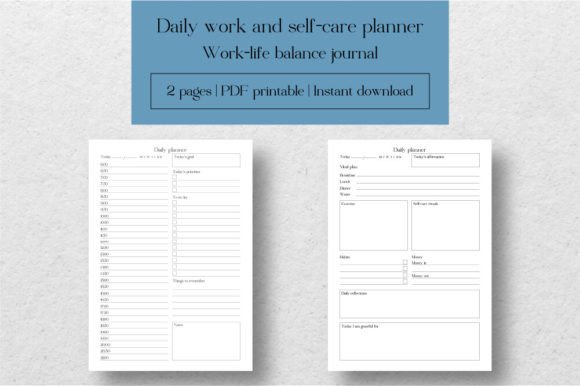
There is a certain kind of relief that comes from having a single place where your work deadlines and your personal well-being coexist. The Daily Work and Self-care Planner Print is exactly that — a two-page PDF that acknowledges you are not just a worker but a whole person with appointments, tasks, emotions, and a need for rest. It is designed to sit beside your keyboard, live in your bag, or hang on your fridge, ready to capture whatever your day throws at you.
What makes this particular planner different from the dozens of other templates online is the quiet emphasis on balance. It does not pretend you can be productive every single hour. Instead, it gives you a structured schedule alongside a dedicated reflection space, so you can track what actually matters — not just what you checked off a list.
How the Daily Planner Fits into Different Lifestyles
One of the biggest challenges with any planning tool is that it works beautifully in theory but falls apart in practice. The Daily Work and Self-care Planner Print avoids that trap by being flexible enough for a variety of real-world situations. Let me walk you through a few scenarios where it truly shines.
The remote worker navigating blurred boundaries
If you work from home, you know the struggle. Your laptop is always within arm's reach, and the line between "work hours" and "off hours" becomes dangerously thin. I have seen people use this planner to physically block out their start and end times in the schedule section, treating it like a contract with themselves. The hour-by-hour layout helps them see where work is creeping into personal time and where personal distractions are hurting focus.
One user I spoke with sets a recurring alarm at 5:30 PM to write a quick self-reflection entry. She jots down one thing she accomplished at work and one thing she did for herself that day. That small ritual has done more for her work-life balance than any time management course ever did.
The parent juggling family and career
Parents between 25 and 45 often feel like they are failing at everything because there is no single system that accommodates school drop-offs, project deadlines, dinner prep, and personal downtime. The Daily Work and Self-care Planner Print works well here because the to-do section can hold both "finish quarterly report" and "buy birthday gift for niece" without judgment.
I have seen parents use the self-reflection segment to note what their child said that made them laugh or a moment of patience they were proud of. That might sound small, but when your day is a blur of obligations, capturing those moments becomes a form of self-care in itself. The planner does not force you to separate your identities — it lets you be a professional and a parent in the same space.
The freelancer or entrepreneur managing chaos
Freelancers and small business owners often operate without the structure that a traditional job provides. Every day is different, and it is easy to let urgent tasks crowd out important but non-urgent ones — including rest. The structured schedule section becomes a lifesaver here. You can assign specific time blocks to client work, admin tasks, marketing, and yes, lunch away from your desk.
I know a graphic designer who prints this planner every Sunday evening and fills out the schedule for the upcoming week. She uses different pen colors: blue for client work, green for personal tasks, and red for self-care activities like a walk or a stretching break. The visual separation helps her see, at a glance, whether her week is lopsided. If there is too much blue and not enough red, she rearranges things before the week even starts.
The student or early-career professional finding their rhythm
If you are in your twenties or early thirties, you are likely juggling coursework, internships, side projects, and a social life that still matters deeply to you. The Daily Work and Self-care Planner Print helps you build habits that will serve you long after graduation. The self-reflection segment is particularly useful here because it encourages you to look back at what worked and what did not.
I recall a recent graduate who used the reflection space to track her energy levels throughout the day. She discovered that her most focused work happened between 10 AM and noon, so she started scheduling her hardest tasks in that window. That kind of personal insight is hard to gain without a consistent practice of looking back, and the planner gives you a gentle nudge to do it daily.
Common Considerations Before You Start Using It
Before you download and print the Daily Work and Self-care Planner Print, there are a few practical things to think about. These are not dealbreakers, but they will help you get the most out of the experience.
Print format and paper choice
The planner comes in A4, A5, and likely other sizes, so think about where you will use it. A4 is great for a desk where you have space to spread out. A5 is more portable if you carry a bag and want to take it to coffee shops or co-working spaces. I recommend a heavier paper stock, around 120 gsm, so the ink from your pen does not bleed through to the other side. Nobody wants to see the ghost of yesterday's to-do list while writing today's.
Digital vs. physical use
This is a printable PDF, but that does not mean you have to use it on paper. Some people load it into a note-taking app like GoodNotes or Notability and write on it with an iPad and stylus. The instant download makes that easy — you have the file immediately and can decide your medium later. I have found that the physical act of writing helps me remember things better, but the digital version is fantastic for searchability and reducing clutter.
Consistency matters more than perfection
One observation from watching people use planners over the years is that the biggest hurdle is not the tool itself but the habit of using it. The Daily Work and Self-care Planner Print is simple enough that you can start using it in under five minutes, but that does not mean you will remember to open it every day. I suggest keeping it in plain sight — clipped to a notebook, pinned to a corkboard, or sitting on your desk mat. Out of sight truly means out of mind for most of us.
What the planner does not do
It is worth acknowledging that no single page can solve deep-rooted issues like chronic overwork or burnout. The self-reflection segment is a prompt, not a therapy session. If you find yourself consistently unable to fit self-care into your day, that is a signal that your schedule or boundaries need a larger reset. The planner can highlight that pattern, but it cannot fix it for you. That is not a limitation of the product — it is the honest reality of any planning tool.
Why the Strengths of This Planner Stand Out
What I appreciate most about the Daily Work and Self-care Planner Print is that it does not try to be everything to everyone. It focuses on three core functions — to-do management, hourly scheduling, and personal reflection — and does them well. The emphasis on life-work balance is not just a tagline; it is built into the structure of the page.
When your to-do list and your self-reflection sit on the same sheet of paper, you are reminded that both are part of your day. You cannot ignore your well-being any more than you can ignore your deadlines. That visual and psychological integration is rare in printable planners, and it makes this one worth trying.
Whether you are a remote worker reclaiming your evenings, a parent trying to remember who you are outside of your roles, or a freelancer building a sustainable practice, this planner gives you a framework. It does not promise to fix everything, but it does promise to hold the space for both your work and your care.