Unlock the Fun: A Complete Guide to 1,000 Easy Jigsaw Sudoku Puzzles
If you love puzzles but feel that classic Sudoku has become a little predictable, it is time to meet its more adventurous cousin: Jigsaw Sudoku. Unlike the standard 3x3 box grids, Jigsaw Sudoku replaces those tidy squares with irregular, jagged regions that twist and wind across the board. The result? A fresh, challenging, and deeply satisfying logic puzzle that keeps your brain engaged from start to finish.
Whether you are a teacher looking for classroom activities, a parent seeking screen-free fun, or an aspiring KDP publisher building a puzzle book empire, a collection of 1,000 Easy Jigsaw Sudoku puzzles is a game-changer. In this article, we will break down everything you need to know about these puzzles, why they matter, how they fit into daily life, and how you can use them for entertainment, education, and even business.
What Is Jigsaw Sudoku? A Beginner-Friendly Explanation
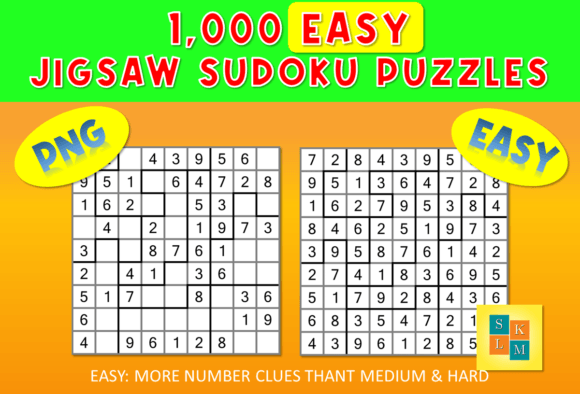
At its core, Jigsaw Sudoku (also called Irregular Sudoku or Geometry Sudoku) follows the same basic rules as classic Sudoku: you must place the numbers 1 through 9 in every row, every column, and every region without repeating a single digit. The twist? The regions are no longer neat 3x3 boxes. Instead, they are irregularly shaped "jigsaw" pieces that often look like snakes, blocks, or abstract shapes.
For example, a region might stretch across five cells in one row and then drop down to include four cells in the row below. That irregular boundary is what makes Jigsaw Sudoku so much more visually interesting and mentally stimulating. Beginners sometimes find it easier because there is no fixed 3x3 box to fall back on, while experienced solvers love it for the fresh logic it demands.
How Easy Jigsaw Sudoku Differs from Hard Jigsaw Sudoku
The difficulty level in Jigsaw Sudoku is not just about the number of given clues—it is also about the shape of the regions. In easy puzzles, the regions are simpler and more block-like, and the starting grid contains more clues. This makes the deduction process smoother and less frustrating for new solvers. Hard Jigsaw puzzles might have wild, thin regions that loop around the board and far fewer clues, requiring advanced logic techniques.
In the 1,000 Easy Jigsaw Sudoku collection, every puzzle is designed to be approachable, making it perfect for casual solvers, students, and anyone who wants a relaxing but engaging mental workout.
Why Jigsaw Sudoku Is More Than Just a Puzzle
Many people think of Sudoku as a simple pastime, but research and experience show that puzzle-solving offers real cognitive benefits. Jigsaw Sudoku, in particular, adds an extra layer of spatial reasoning that classic Sudoku lacks.
- Improves logical thinking: You must analyze constraints across rows, columns, and irregular regions simultaneously.
- Boosts pattern recognition: Irregular region shapes force you to "see" numbers in new ways.
- Enhances concentration: A single puzzle can train your mind to focus for 10–20 minutes at a time.
- Reduces stress: The structured, rule-based nature of the puzzle promotes a calm, meditative state.
- Builds confidence: Completing a puzzle—especially an irregular one—gives a genuine sense of accomplishment.
These benefits make Jigsaw Sudoku a powerful tool not just for entertainment, but for personal growth and mental maintenance at any age.
Practical Uses for 1,000 Easy Jigsaw Sudoku Puzzles
This collection is not just a pile of puzzles—it is a versatile resource that fits into many areas of modern life.
In the Classroom and Educational Settings
Teachers and educators have long used Sudoku to teach logic, patience, and number sense. With 1,000 easy Jigsaw puzzles, you have a year's worth of ready-made material. They are excellent for:
- Warm-up activities at the start of a math class
- Brain breaks between lessons
- Enrichment for fast finishers
- Substitute teacher plans
- After-school logic clubs
Because the puzzles are easy, students in grades 4 and up can typically solve them with a little guidance. And since Jigsaw Sudoku uses the same numbers 1–9 as classic Sudoku, it reinforces number placement without requiring advanced math skills.
At Home: Family Fun and Screen-Free Entertainment
Looking for a way to unplug from devices? Print out a few puzzles and gather the family. Easy Jigsaw Sudoku is accessible to kids, parents, and grandparents alike. You can:
- Solve puzzles together on a rainy afternoon
- Challenge each other to see who finishes first
- Use them as a calm activity before bedtime
- Keep a stack in the car for road trips
The PNG files included in the zipped package print beautifully at high resolution, so you can produce crisp, clean worksheets at home or at a local print shop.
During Seminar Breaks and Corporate Events
Conferences, seminars, and workshops often have long breaks where attendees need to recharge. Offering a puzzle table with easy Jigsaw Sudoku can be a hit. It gives people a quiet, focused activity that resets their attention. Many professionals find that solving a single puzzle during a break helps them return to the session with renewed mental clarity.
How This Puzzle Collection Fits into the KDP Journey
If you are on a KDP (Kindle Direct Publishing) journey, you already know that puzzle books are among the most popular and profitable niches on Amazon. However, creating original puzzles from scratch is time-consuming—especially if you need to design irregular regions for Jigsaw Sudoku.
This listing solves that problem by providing 1,000 unique, ready-to-use puzzles with matching solutions. Here is what you get in the zipped file:
- 1,000 puzzle images in PNG format
- 1,000 solution images in PNG format
- High-resolution output suitable for print
- A tool recommendation to help you assemble books faster
For KDP publishers, this means you can skip the puzzle generation phase entirely and focus on layout, cover design, and marketing. The included tool suggestion (mentioned in the listing) can further streamline how you compile and format pages for publication.
Why Easy Jigsaw Sudoku Is a Smart Niche for KDP
Classic Sudoku books are everywhere—competition is fierce. But Jigsaw Sudoku, especially at the easy level, is a less saturated niche with passionate fans. Buyers often search for "easy jigsaw sudoku" or "irregular sudoku for beginners," and a well-packaged book of 100 or 200 puzzles can rank well with the right keywords.
Because this collection includes 1,000 puzzles, you can create multiple volumes, seasonal editions, or even a giant compilation. The solutions are included, so you can place them at the back of the book without manual labor.
Clarifying Common Misunderstandings About Jigsaw Sudoku
New solvers sometimes hesitate to try Jigsaw Sudoku because they think it will be too hard. Let us clear up a few common assumptions:
- Myth: Jigsaw Sudoku is only for experts. Truth: Easy Jigsaw puzzles are designed for beginners and casual solvers. The irregular regions add variety, not necessarily difficulty.
- Myth: You need to be good at math. Truth: No arithmetic is required. Only logic and pattern recognition matter.
- Myth: The shapes make it impossible. Truth: With practice, you learn to use the region shapes as visual cues, not obstacles.
- Myth: It takes much longer than classic Sudoku. Truth: Easy Jigsaw puzzles often take a similar amount of time as easy classic Sudoku, sometimes even less because the irregular regions can give you extra constraints to work with.
Understanding these points helps both solvers and publishers feel confident about offering Jigsaw Sudoku to a broad audience.
How to Get the Most Out of This 1,000-Puzzle Collection
Whether you are buying this for personal use or for publishing, here are some practical tips to maximize the value.
For Personal Solvers
- Print puzzles at home on standard letter or A4 paper using the high-resolution PNG files.
- Start with the first puzzle and work your way through at your own pace—there is no rush.
- Use a pencil and eraser; you will rarely need to erase, but it is helpful when experimenting.
- Keep a solved puzzle log to track your progress and favorite region shapes.
For KDP Publishers
- Open the zipped file and review the puzzle and solution PNGs for quality.
- Use the recommended tool from the listing to import puzzles into your layout software (such as Canva, Adobe InDesign, or Affinity Publisher).
- Consider grouping puzzles into books of 100 or 200 to keep production manageable.
- Add a brief instruction page at the front explaining how Jigsaw Sudoku works—this helps reduce returns and negative reviews.
- Include a solution section at the back using the provided solution images.
If you need different file types—such as JPEG, PDF, or editable spreadsheet layouts—the seller invites you to reach out. Customization requests are often welcomed, especially for bulk or commercial use.
The Bigger Picture: Puzzles in the Digital Age
In a world where digital distractions are constant, analog puzzles like Jigsaw Sudoku offer a valuable counterbalance. They require focused attention, patience, and a willingness to think step-by-step. For children, they build executive function skills. For adults, they provide a mental reset. For seniors, they help maintain cognitive sharpness.
This collection of 1,000 Easy Jigsaw Sudoku puzzles is more than a product—it is a toolkit for mental wellness, educational enrichment, and creative publishing. Whether you are solving your first puzzle or publishing your tenth book, the irregular world of Jigsaw Sudoku invites you to think differently, one number at a time.
Final Thoughts
Jigsaw Sudoku is not just a variation—it is a whole new way to experience logic puzzles. The easy level makes it accessible to everyone, while the irregular regions keep it fresh and engaging. With 1,000 puzzles, solutions included, and high-resolution PNG files ready for print or publishing, this collection offers incredible value for teachers, families, and KDP entrepreneurs alike.
If you have been looking for a fun, brain-boosting activity that works at home, in class, or as a business asset, easy Jigsaw Sudoku is a smart choice. Give it a try, and discover why irregular shapes can lead to beautifully logical thinking.