Gratitude Journal Interior Cover: A Practical Foundation for Daily Reflection
Putting together a gratitude journal that feels both personal and professional is not as simple as picking a nice cover and filling pages with prompts. The structure, layout, and consistency of the interior matter just as much as the content itself. The Gratitude Journal Interior Cover, paired with the Gratitude journal template 100, offers a ready-to-use foundation for anyone creating a printed journal for themselves, their clients, or their audience. This combination of pre-formatted files aims to remove the friction from production while maintaining a polished, usable end product. Below, I examine what this set includes, how it performs in practice, and who stands to gain the most from it.
What the Gratitude Journal Interior Cover Offers
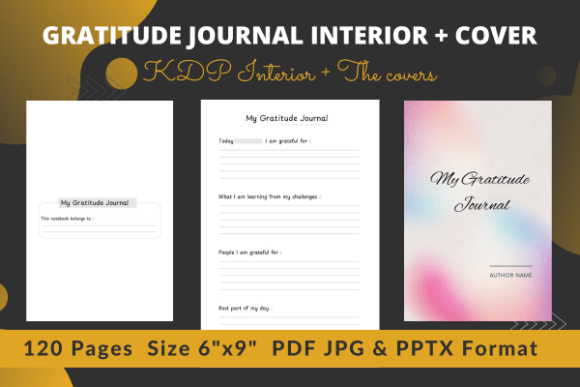
At its core, this product provides a complete interior layout for a 6x9-inch gratitude journal spanning 120 pages. The package includes PDF, JPG, and PPTX files, giving you flexibility in how you edit, preview, or print the content. The PDF is specifically described as 100 percent ready for KDP uploading, which means you can take the file directly to Amazon’s Kindle Direct Publishing platform without additional formatting steps. The word “interior cover” in the title refers to the layout templates that structure each page inside the journal, not the exterior book cover itself.
The Gratitude journal template 100 component indicates that there are 100 editable prompts or structured entries within those 120 pages. That leaves room for introductory pages, index pages, or closing notes. The prompts are designed around gratitude practices, encouraging users to note what they are thankful for, reflect on positive experiences, and build a consistent habit of appreciation. The files are print-ready, with high-resolution interiors that maintain clarity whether you are printing at home or through a professional service.
Key Characteristics and Design Specifications
Understanding the technical details helps you decide whether this template fits your project. The dimensions are a standard 6x9 inches, a size that works well for both personal use and commercial publishing. It is large enough to allow comfortable writing space but compact enough to carry in a bag or place on a desk. The file set includes a no-bleed option, which simplifies the printing process for POD (print on demand) services that do not require full-bleed margins.
The high-resolution interior files ensure that text, lines, and any decorative elements appear crisp on paper. This matters because a fuzzy or pixelated layout undermines the professional feel of the finished journal. The PPTX file is a useful addition if you want to customize the layout beyond the basic prompts. You can move elements, change fonts, or adjust spacing in PowerPoint or Google Slides, then export to PDF or print directly.
The 100 editable entries give you room to personalize the journal for a specific audience or to include your own branding. If you are a coach, therapist, or educator, you might want to rephrase prompts to align with your methods. If you are a publisher, you can insert your logo and adjust the color scheme before uploading to KDP. The remaining 20 pages in the 120-page count can house a title page, a how-to-use section, a table of contents, or a final reflection page.
Practical Value in Real-World Use
From a practical standpoint, the Gratitude Journal Interior Cover solves several common problems that arise when creating a guided journal from scratch. The first is layout consistency. When you design your own journal, it is easy to end up with uneven spacing, misaligned prompts, or inconsistent headers. This template provides a uniform structure across all 100 entries, so the user experience remains predictable from page to page. That consistency builds trust and makes the journal easier to use daily.
Another practical advantage is the time saved on formatting. Formatting a 120-page book for KDP can take hours, especially if you are not familiar with bleed settings, trim sizes, and margin requirements. The PDF in this package is described as ready to upload, meaning you can skip that entire workflow and move directly to the publishing step. For someone who wants to launch a product quickly or who is testing a niche market, that efficiency is valuable.
In terms of real user experience, a gratitude journal with clearly defined prompts tends to encourage more consistent use than a blank notebook. The structured approach reduces decision fatigue. Instead of wondering what to write each day, the user simply follows the prompt. Over the course of 100 entries, this habit can become ingrained. For professionals such as life coaches or wellness bloggers who recommend gratitude practices to their clients, having a well-designed journal to offer as a resource adds credibility to their guidance.
Who Benefits Most from This Interior Cover
This template suits a range of users, but certain groups will find it especially practical. Independent publishers and self-publishers on KDP are an obvious audience. If you are building a catalog of journals or planners, having a reliable interior template that you can reuse with minor modifications saves both time and money. You can produce multiple variations by changing the cover and adjusting the PPTX file, then upload each as a separate listing.
Entrepreneurs and small business owners who sell digital or physical products may also benefit. If you run an Etsy shop for printables or a small print-on-demand store, this template gives you a ready-made product to offer. You can sell the PDF as a digital download or order printed copies to sell at events. The high resolution and print-ready format mean you do not need to worry about technical hiccups when fulfilling orders.
Coaches, therapists, and educators who use journaling as part of their practice can adapt the template for their clients or students. Because the file is editable in PPTX, you can tailor the language to fit a specific program. For example, you might add prompts about professional gratitude for a workplace wellness workshop or include reflection questions focused on personal growth for a coaching cohort. The flexibility to edit without needing advanced design software is a practical advantage.
Serious hobbyists who enjoy creating their own journals for personal use will also find value. If you prefer to print your own journals at home or through a local print shop, the no-bleed option and standard dimensions make it straightforward. You can customize the look to match your taste before printing a single copy for yourself.
Quality, Usability, and Long-Term Value
The quality of the files affects how the final product is perceived. High-resolution interiors ensure that even small details like lines, borders, or icons remain sharp. This might not matter much if you are printing a single copy for yourself, but it matters a great deal if you are selling copies to customers who expect a clean, professional appearance. A blurry or low-resolution interior can make an otherwise good product look amateurish.
Usability is strong because the template follows a predictable pattern. Users know what to expect on each page, which reduces confusion and helps them establish a routine. The 100-entry structure also provides a clear endpoint. Some people prefer having a finite number of pages because it creates a sense of accomplishment when they complete the journal. That sense of completion can motivate them to buy another journal or recommend it to others.
Long-term value depends on how you use the template. If you are a publisher, you can treat this as a base design that you modify for different themes, seasons, or target audiences. The PPTX file allows for extensive customization without requiring you to rebuild the layout from scratch. Over time, you could produce a series of gratitude journals with different covers and minor interior variations, building a small catalog from a single template investment.
Flexibility and Customization Options
The inclusion of multiple file formats is one of the stronger aspects of this package. The PDF is ready for immediate upload, which is useful if you want to publish quickly. The JPG files can be used for previews, social media mockups, or sample pages. The PPTX file is where the real customization happens. You can change fonts, adjust colors, add or remove fields, and insert your own branding elements. For someone comfortable with PowerPoint or Google Slides, this opens up many possibilities without requiring Adobe InDesign or other expensive software.
That said, the editable range is limited to what the PPTX file allows. If you want to change the overall layout dramatically or add complex graphics, you might need more advanced tools. But for most practical purposes, the PPTX format provides enough control to tailor the journal to a specific audience or use case.
Potential Limitations and Considerations
No product is without trade-offs, and this interior cover has a few worth noting. First, the template is built around a specific set of gratitude prompts. If you want a completely different style of journal, such as one focused on goal setting or habit tracking, this particular layout may not fit. The prompts are what define the template, so altering them extensively might require more editing than you expect.
Second, the 120-page count and 100-entry structure means that roughly 20 pages are used for non-prompt content. If you prefer a journal with no introductory pages or want to fit in more prompts, you would need to modify the layout yourself or look for a template with a higher prompt density.
Third, while the PDF is described as KDP-ready, it is always wise to double-check margins, fonts, and image resolution before uploading. Printing services have specific requirements, and even minor issues can cause delays or rejections. Test the file with a sample print or use Amazon’s preview tool to verify the layout before going live.
Finally, the template does not include an exterior cover design. You will need to source or create a separate cover file to complete the book. The interior cover name refers to the inside layout, not the front or back cover. If you are new to publishing, this distinction is important to keep in mind so that you do not accidentally upload the interior file as the cover.
Final Thoughts on the Gratitude Journal Interior Cover
The Gratitude Journal Interior Cover, together with the Gratitude journal template 100, provides a practical and efficient foundation for creating a printed gratitude journal. It addresses the need for consistent layout, professional resolution, and straightforward KDP upload, all while leaving room for customization through the included PPTX file. For self-publishers, small business owners, coaches, educators, and serious hobbyists, this template can reduce the time and effort required to produce a usable product. It is not a one-size-fits-all solution, but for its intended purpose—creating a structured, print-ready gratitude journal—it delivers reliable results. If your goal is to publish a journal that looks clean, works well in practice, and requires minimal formatting work, this interior cover is worth considering. Simply pair it with a strong cover design, review the file against your printer’s specifications, and you will have a professional product ready to share with your audience.